
Sunshine Reeves: Master Silversmith of the Navajo Tradition

Updated: Sep 17
Born in Twin Lakes, New Mexico in 1966, Daniel “Sunshine” Reeves was raised within a family of accomplished New Mexico silversmiths. He learned the art of silversmithing at the age of 24 from his older brothers, Gray Reeves and David Reeves—both respected artists in their own right. From this strong familial foundation, Sunshine Reeves went on to become one of the most distinguished and influential Navajo silversmiths in the country.

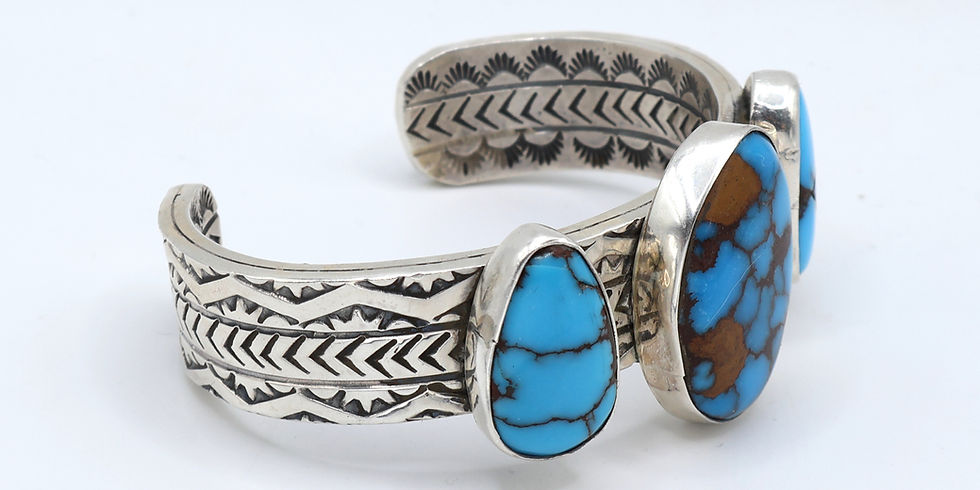
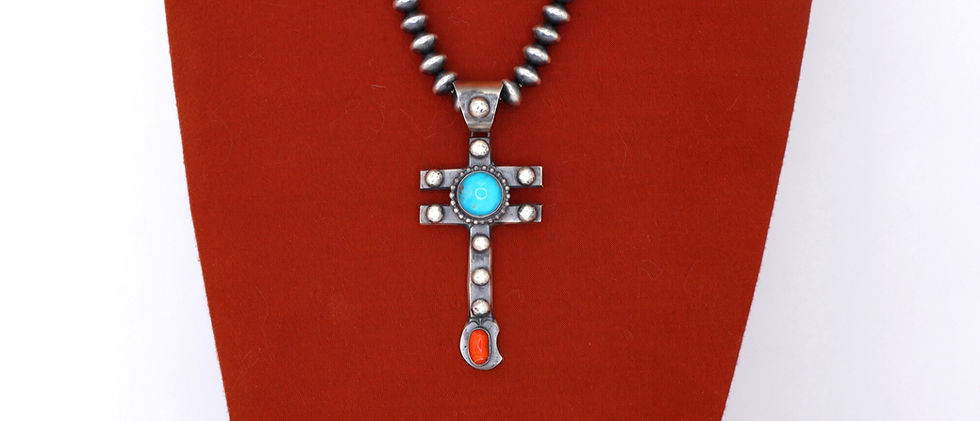
Reeves’ work is deeply rooted in traditional Navajo silversmithing while simultaneously pushing the boundaries of form and scale. His creations range from bracelets and belt buckles to silver boxes, knives, bowls, candle holders, and even kerosene lanterns. Each piece begins as a flat sheet of sterling silver, which is then meticulously hand-stamped, formed, and shaped entirely by hand.
The hallmark of Sunshine Reeves’ work is his extraordinary stampwork. “Most people have no idea how complex the process is to create these unique art forms,” he has said—and that complexity is central to the power of his work. On an average piece, Reeves may use 10 to 20 different handmade stamps. Each individual mark represents a separate hammer blow, applied with precision and intention. The process is labor-intensive and time-consuming, but the result is a richly textured surface alive with depth, rhythm, and movement. No two works are ever exactly alike.

While often referred to as jewelry, Reeves’ creations transcend adornment. Whether a bracelet or a silver box, each object stands as a fully realized work of art—functional, sculptural, and deeply expressive. His ability to balance repetition with variation, and tradition with innovation, has made his work instantly recognizable and highly sought after by collectors.
Sunshine Reeves is widely recognized as a master in his field. He earned Best of Show at the Santa Fe Indian Market in 1997—an achievement that set him apart nationally—and Best in Class in 1998. He also received Best of Show at the Inter-tribal Indian Ceremonial, further cementing his reputation for excellence. His work has been exhibited in major institutions including the Heard Museum and the Peabody Museum at Harvard University, reflecting both its artistic significance and cultural importance.
Today, Sunshine Reeves’ work is collected worldwide, with strong international followings in Japan, Europe, and Korea. His pieces are featured in galleries and museums across the United States and are prized for their technical mastery, cultural integrity, and unmistakable presence.

To collect a work by Sunshine Reeves is to own more than a piece of silver—it is to hold a testament to generations of knowledge, disciplined craftsmanship, and artistic vision. Each piece carries forward the legacy of Navajo silversmithing while standing firmly as a singular work of contemporary art.