
Richard Singer: Carrying the Navajo Legacy Forward in Sterling and Stones

Some artists inherit a profession. Others inherit a legacy.
For Navajo silversmith Richard Singer, jewelry making represents generations of family tradition, cultural pride, and artistic storytelling. Every bracelet, pendant, buckle, ring, or necklace he creates reflects not only his own craftsmanship, but also the teachings of those who came before him.
A Heritage Rooted in the Navajo Nation
Richard Singer is a third-generation Navajo silversmith from Standing Horse Mesa on the Navajo Nation in Arizona. He belongs to the Ta'neeszahnii (Tangle Clan) and was born for the Kinyaa'áanii (Tower House Clan), reflecting the importance of clan identity within Diné culture.
His artistic roots run deep.
Richard's grandfather, Tsinnigine Hathali, was both a respected Navajo medicine man and a silversmith. He introduced his son, the legendary Tommy Singer, to silversmithing at an early age, laying the foundation for one of the most recognizable names in contemporary Navajo jewelry.
Tommy Singer became internationally known for his distinctive sterling silver overlay work, his innovative use of colorful turquoise and coral chip inlay, and his incorporation of gold into traditional Navajo jewelry. His bold style helped influence generations of Native artists and collectors alike.
Growing up surrounded by this remarkable creative family, Richard witnessed jewelry being made almost every day. Silver wasn't simply a material—it was part of everyday life.
Learning from a Master
Although Richard was immersed in the world of silversmithing as a child, he didn't immediately choose it as his career.
Like many Native artisans, life required balancing practical work with artistic passion. During his early adulthood, Richard worked in construction, and he continues to do so during the week. It wasn't until 1989, when he was around twenty years old, that he formally began learning under his father's guidance.
That apprenticeship proved invaluable.
Rather than simply teaching techniques, Tommy Singer passed along decades of artistic knowledge, design philosophy, and respect for the materials. Richard became the only one of Tommy's sons to fully embrace the family trade—a decision that brought great pride to his father.
Today, Richard continues creating jewelry primarily during evenings and weekends, dedicating countless hours outside his regular work schedule to preserve his family's artistic heritage.
A Style That Honors Tradition
While Richard's work clearly reflects the influence of his father, it has developed into a style that is uniquely his own.
His jewelry often features:
Sterling silver overlay
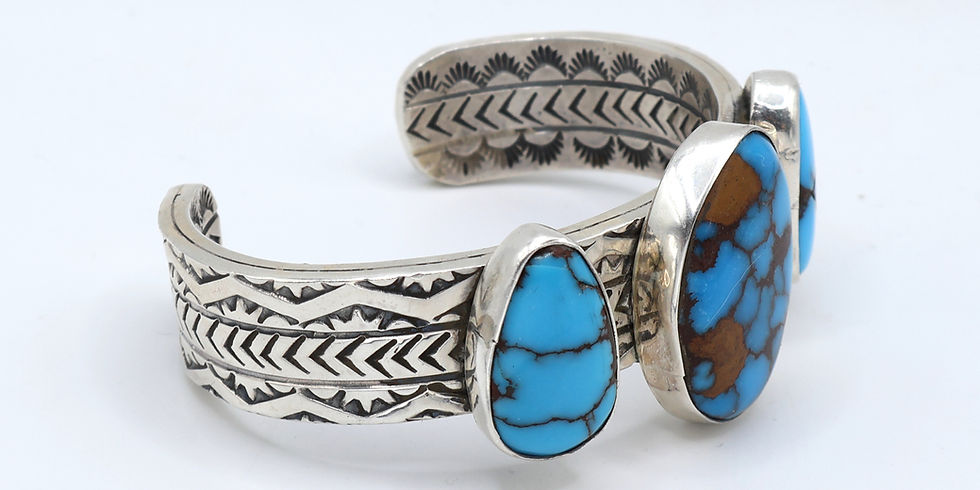
Hand-stamped and deeply textured silver
Bold geometric Navajo designs
Traditional Diné symbolism
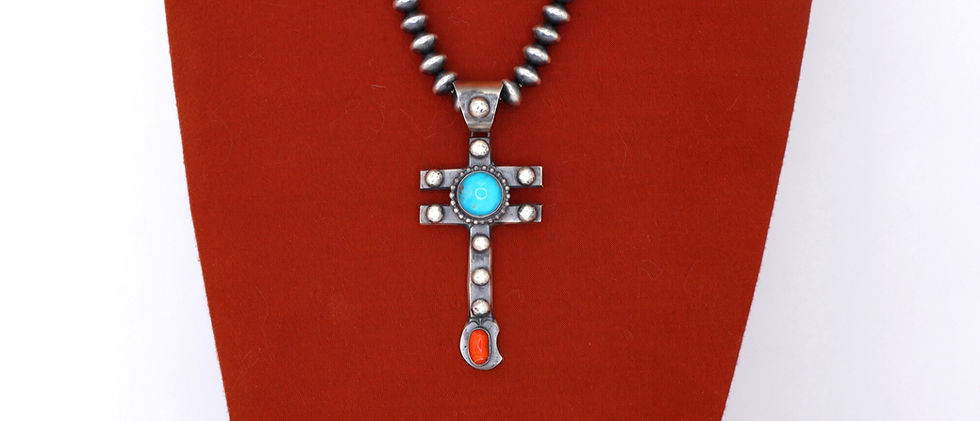
Turquoise, coral, and other natural stones
Storyteller imagery
Navajo rug-inspired patterns
Many of his pieces celebrate the beauty of the Southwest while honoring Navajo beliefs surrounding nature. Mountains, water, animals, and the sky frequently inspire his designs, reflecting the deep relationship between the Diné people and the land they call home.
Collectors also appreciate Richard's beautifully detailed stamp work and dimensional silver surfaces, which create depth and movement even before a single stone is added.
Creating with Intention
For Richard, jewelry making is more than craftsmanship—it is a thoughtful process rooted in gratitude and respect.
Because the silver and stones come from the earth, he approaches each piece with a spirit of appreciation. Prayer and reflection are an important part of his creative process, serving as a reminder that these natural materials should be treated with care and purpose.
Whether designing a ring for everyday wear or an elaborate statement necklace, Richard strives to create something that feels personal to its future owner. No two handmade pieces are exactly alike, allowing each work to possess its own individual character.
Continuing Tommy Singer's Legacy
Anyone familiar with Tommy Singer's jewelry can often recognize echoes of that famous style in Richard's work. Yet Richard has never sought to simply duplicate his father's designs.
Instead, he continues the artistic philosophy passed down through his family—honoring Navajo traditions while allowing each piece to speak with its own voice.
His jewelry serves as a bridge between generations, preserving techniques and symbolism that have been handed down within his family while introducing them to new collectors around the world.
Why Collectors Love Richard Singer
Collectors are drawn to Richard Singer's work for several reasons:
He represents one of Navajo silversmithing's most respected family lineages.
Every piece is individually handcrafted rather than mass-produced.
His designs balance traditional Navajo symbolism with timeless wearability.
His detailed overlay and stamp work showcase exceptional craftsmanship.
His jewelry reflects both family heritage and his own artistic identity.
In a world increasingly filled with factory-made imitations, Richard Singer continues to create authentic wearable art that carries genuine history, culture, and heart.
When you wear one of his pieces, you're not simply wearing sterling silver and natural stone—you are carrying forward generations of Navajo artistry, family tradition, and craftsmanship that continues to thrive today.
At Santa Fe Sun Handmade, we are honored to feature authentic handmade jewelry by artists like Richard Singer, whose work represents the enduring beauty of Navajo silversmithing and the stories that can only be told through the hands of the maker.