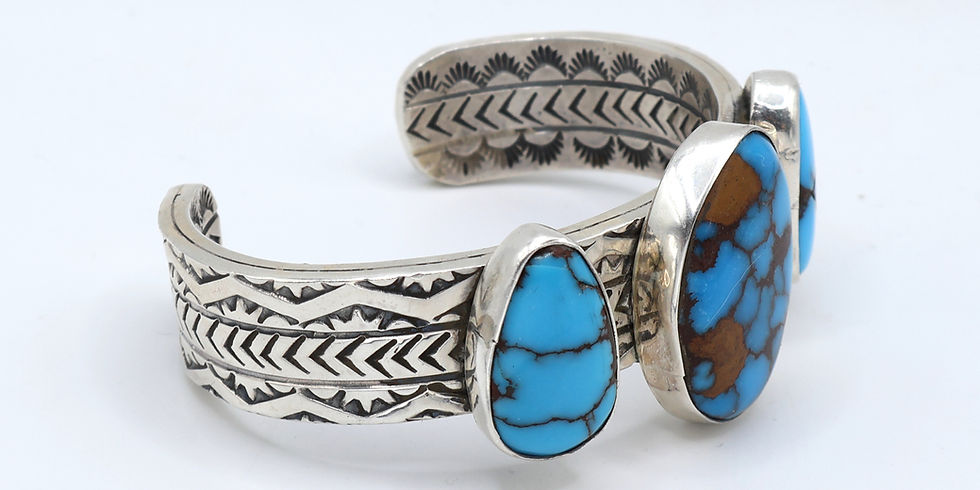

Angelo Secetero: The Courage Required to Begin and the Discipline Required to Continue

Every accomplished artist begins somewhere.
Long before collectors recognize a silversmith’s name, before decades of experience shape a signature style, there are the early pieces—the work created while techniques are still being explored, confidence is growing, and an artistic voice is beginning to emerge.
At just 17 years old, Navajo silversmith Angelo Secetero is already taking his place at the jeweler’s bench. He is the son of respected Navajo silversmith Eddie Secatero Jr., giving Angelo the opportunity to learn within a family where the knowledge of working with silver and stone is already deeply rooted.
But carrying a respected family name is only the beginning. Angelo must still put in the hours, learn the techniques, develop his own instincts, and ultimately discover what he wants his work to say.
Learning from One Generation to the Next
The passing of knowledge from one generation to another has always been essential to the continuation of Navajo silversmithing.
Growing up with an accomplished artist as a father gives Angelo an invaluable foundation. He can observe not only how a piece is constructed, but also the patience, problem-solving, and discipline behind the finished work. He is learning that silversmithing is more than knowing how to stamp, solder, shape, and set a stone. It requires years of practice and a willingness to keep learning from every piece.
Angelo’s work naturally begins within the artistic world surrounding him, including the influence and experience of his father. Over time, however, he will make his own choices. His techniques will become more confident. His preferences will become clearer. Certain stones, forms, and details may begin appearing again and again until a style emerges that belongs distinctly to him.
That is one of the most exciting parts of following a young artist’s career: watching inherited knowledge gradually develop into an individual artistic voice.
Every Artist Deserves Room to Grow
It is easy to admire an artist who has spent 30 or 40 years mastering a craft. Their work may be technically extraordinary, immediately recognizable, and highly sought after by collectors.
But no artist begins at that level.
Young artists develop at different speeds and bring different natural talents to the bench. Some demonstrate remarkable technical precision almost immediately. Others grow slowly and steadily, discovering their strengths through experimentation and repetition. One may become known for intricate stampwork, while another develops a gift for stone selection, sculptural silverwork, or beautifully wearable everyday designs.
There is no single path—and there should not be.
Supporting young artists should not be limited to searching for the next famous name. It is about recognizing the courage required to begin, the discipline required to continue, and the importance of giving young people a reason to believe their work matters.
When someone purchases a piece from a young silversmith, that support becomes tangible. It helps pay for silver, stones, tools, and the many supplies required to keep creating. Just as importantly, it tells the artist that someone saw value in what they made.
That encouragement can be powerful, especially at 17.
Collecting a Chapter, Not Just a Piece
There is something especially meaningful about owning work from the beginning of an artist’s career.
An early piece captures a particular moment—a young silversmith’s developing technique, emerging ideas, and first steps toward finding a personal style. It may show the influence of family and tradition while also offering the earliest hints of where that artist may eventually take the work.
Twenty years from now, Angelo will be 37. By then, he may have spent decades at the bench, created thousands of pieces, refined his techniques, and developed a style entirely his own.
If so, the piece you purchase today will hold a story that cannot be recreated. It will be from his early years—a tangible record of where his journey began.
Of course, no one can predict where any artist’s career will lead, and buying from a young silversmith should never be reduced to speculation about future monetary value.
The greater reward is being able to say, “I supported this artist when he was just beginning.”
If that artist later becomes widely collected, the story becomes even sweeter.
Keeping the Art Moving Forward
Traditional art forms remain alive because each generation chooses to learn them—and because collectors choose to support the people doing that work.
Admiring celebrated artists such as Eddie Secatero Jr. is important. Their skill, experience, and dedication deserve recognition. But the future of Navajo silversmithing also depends upon making room for teenagers and young adults who are still learning, experimenting, and developing.
Not every early piece will be perfectly refined. That is part of what makes it honest. Growth is not a flaw in an artist’s story; it is the story.
When we support young artists at every level of ability and experience, we are not simply purchasing jewelry. We are helping provide the materials, confidence, and opportunity they need to keep going.
The Beginning of Angelo’s Story
At 17, Angelo Secetero has many years ahead of him to explore what kind of silversmith he wants to become. He carries knowledge passed down through his father, Eddie Secatero Jr., but the artistic path ahead will be Angelo’s own.
His techniques will evolve. His designs may change. His artistic voice will become clearer with every piece he makes.
What remains unchanged is the significance of this moment: he has begun.
Owning one of Angelo’s pieces today means owning a small part of that beginning. It is wearable art made by a young Navajo silversmith at the start of a journey whose direction is still unfolding.
And 20 years from now, you may look down at that piece and realize you are holding something wonderfully special:
A piece from a seasoned artist’s early years.